Cities & PlacesCities & Places
Samarkand is one of the oldest cities in Central Asia, with more than two and a half thousand years behind it. And nearly everything you are coming to see was built in a single century out of those twenty-five.
Самарканд — один из древнейших городов Центральной Азии, его история насчитывает более двух с половиной тысяч лет. И почти всё, что вы приедете сюда смотреть, построено за одно столетие из этих двадцати пяти.

The city stood here under Persian kings, under Alexander, under Arab governors — and then, in 1220, Genghis Khan took it and destroyed it so thoroughly that it never returned to its old walls: the ancient settlement still lies in mounds to the north, while life moved south. What you will see begins in 1370, when Timur made Samarkand his capital and spent the next thirty-five years bringing craftsmen here from every land he had taken.
Город стоял здесь при персидских царях, при Александре, при арабских наместниках — а потом, в 1220 году, был взят Чингисханом и разрушен так, что вернулся не в прежние стены: старое городище осталось лежать холмами к северу, а жизнь перешла южнее. То, что вы увидите, начинается с 1370 года, когда Тимур сделал Самарканд столицей и следующие тридцать пять лет свозил сюда мастеров со всех завоёванных земель.
Hence this city's particular quality: it did not accumulate in layers, the way most ancient capitals did. It was designed. And designed by a man who wanted a visitor, on seeing it, to understand without words who ruled here.
Отсюда особое свойство этого города: он не нарастал слоями, как большинство древних столиц. Он был задуман. И задуман человеком, который хотел, чтобы приезжий, увидев его, понял без слов, кто здесь правит.
The second thing worth knowing in advance: the most interesting things here were built not by Timur but by his grandson. Ulugh Beg ruled Samarkand for forty years, counted stars, and built an observatory where he measured the length of the year to within twenty-five seconds — nearly two centuries before the telescope existed. He also built the madrasa where he taught himself. He was killed on his own son's orders.
Второе, что стоит знать заранее: самое интересное здесь построил не Тимур, а его внук. Улугбек правил Самаркандом сорок лет, считал звёзды и построил обсерваторию, где определил длину года с ошибкой всего в двадцать пять секунд — почти за два века до того, как появился телескоп. Он же построил медресе, где преподавал сам. Его убили по приказу собственного сына.
The city deserves two days. In one you will manage to look, but not to understand.
Город стоит того, чтобы отвести ему два дня. За один вы успеете посмотреть, но не успеете понять.
Samarkand's age is given differently in different sources: 2,500 years, 2,750, and "no less than 3,000". The disagreement is not a quarrel but a matter of method: the figures rest on different layers of excavation at the Afrasiab site, and each new expedition pushes the lower boundary deeper. We give the cautious one.
Возраст Самарканда в разных источниках называют по-разному: 2500 лет, 2750 и «не менее 3000». Расхождение не в спорах, а в методе: цифры опираются на разные слои раскопок городища Афрасиаб, и каждая новая экспедиция отодвигает нижнюю границу глубже. Мы называем осторожную.
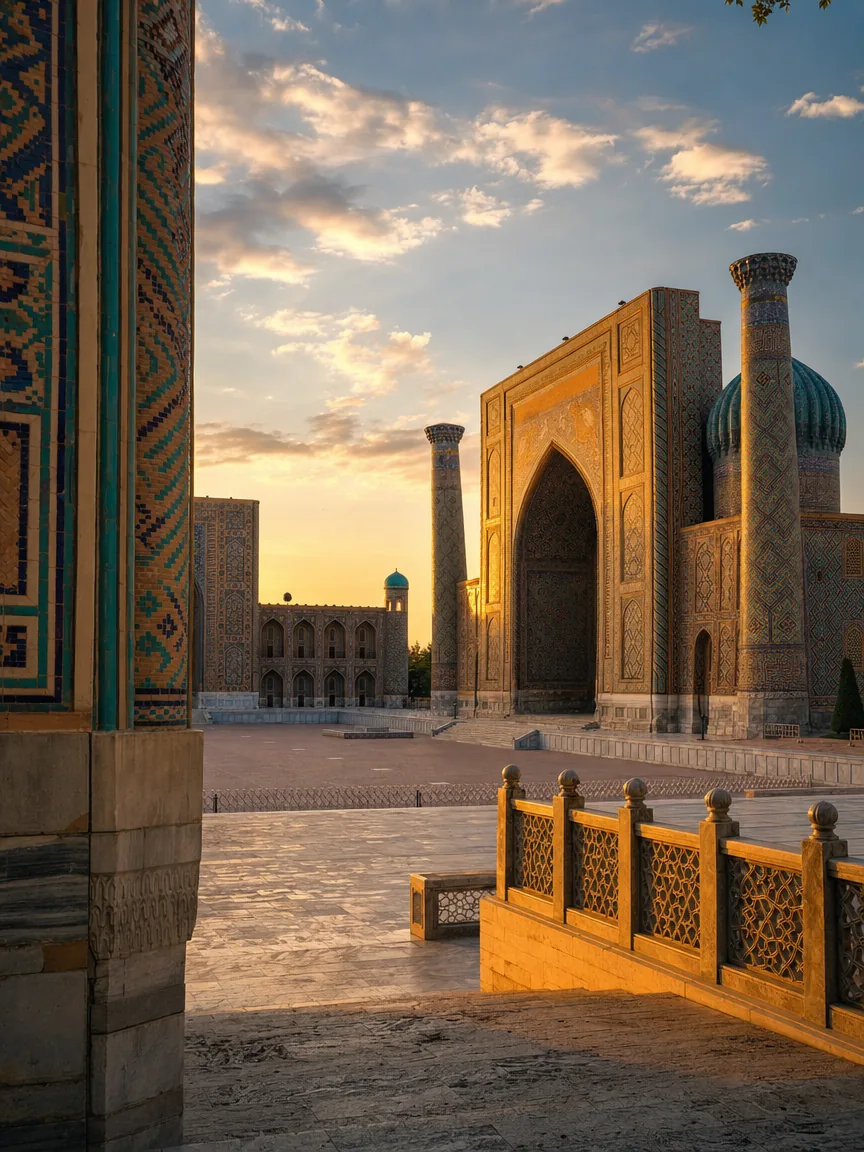
Three buildings stand on three sides of the square, built two hundred years apart — and this is no accident of neighbourhood. The second was built as an answer to the first.
Три здания стоят по трём сторонам площади, и построены они с разницей в двести лет — но это не случайное соседство. Второе строили как ответ первому.
The Ulugh Beg Madrasa, on your right, is the earliest: 1417–1420. What was taught here was not only theology — Ulugh Beg lectured on astronomy himself, and mathematicians from his observatory taught alongside him. Fifty cells; the inscription above the entrance promises a façade twice the height of the sky.
Медресе Улугбека справа — самое раннее, 1417–1420 годы. Здесь учили не только богословию: Улугбек читал лекции по астрономии сам, среди преподавателей были математики его обсерватории. Пятьдесят келий, надпись над входом обещает, что фасад вдвое выше неба.
Two centuries later, Sher-Dor was built facing it, on the kosh principle: two buildings set face to face as mirror images. The architect Abdul Jabbar took the proportions of the Ulugh Beg Madrasa and repeated them. Stand in the square and compare: the intention is visible, the match is not — Sher-Dor's domes are heavier, its silhouette thicker. Two hundred years later a man tried to answer another man's building as an equal, and in that answer you can see what those two centuries changed.
Через двести лет напротив построили Шер-Дор — по принципу «кош», когда два здания ставят лицом друг к другу зеркально. Архитектор Абдулджаббар взял пропорции медресе Улугбека за основу и повторил их. Стойте на площади и сравнивайте: замысел виден, а совпадения нет — купола Шер-Дора тяжелее, силуэт грузнее. Двести лет спустя человек попытался ответить чужому зданию на равных, и по этому ответу видно, что изменилось за двести лет.
On Sher-Dor's portal is the thing people come here to photograph: a maned beast, lion and tiger at once, running down a doe, with a human-faced sun rising on its back. Living creatures are almost never depicted in the architecture of mosques and madrasas, and there is more than one explanation for this mosaic: a memory of pre-Islamic sun symbolism, the influence of neighbouring Persia where such images were current, or a ruler's plain statement about himself. There is no single right answer.
На портале Шер-Дора — то, ради чего сюда приходят фотографировать: зверь с гривой, похожий на льва и на тигра сразу, догоняет лань, а на его спине восходит солнце с человеческим лицом. Изображения живых существ в архитектуре мечетей и медресе почти не встречаются, и объяснений этому мозаичному сюжету несколько: отсылка к домусульманской солнечной символике, влияние соседней Персии, где такие изображения были в ходу, или прямое послание правителя о себе самом. Единственно верного ответа нет.
The third, Tilya-Kori, was finished in 1660, and it is not only a madrasa but the city's main mosque — the earlier one, Bibi-Khanym, was falling apart by then. The name means "covered in gold"; go inside, into the prayer hall: nothing on the outside prepares you for that interior.
Третье, Тилля-Кари, достроили в 1660 году, и это уже не только медресе, но и главная городская мечеть — прежняя, Биби-Ханым, к тому времени разрушалась. Название значит «покрытое золотом»; заходите внутрь, в молитвенный зал: снаружи об этом интерьере ничего не говорит.
When to come. Early morning or towards sunset — the square was built for emptiness and low light; at midday it goes flat. Allow an hour and a half to two hours: you go inside all three, and the inner courtyards are half of it.
Когда приходить. Ранним утром или к закату — площадь рассчитана на пустоту и на низкое солнце, в полдень она выцветает. Заложите полтора-два часа: во все три здания заходят внутрь, и внутренние дворы — половина впечатления.
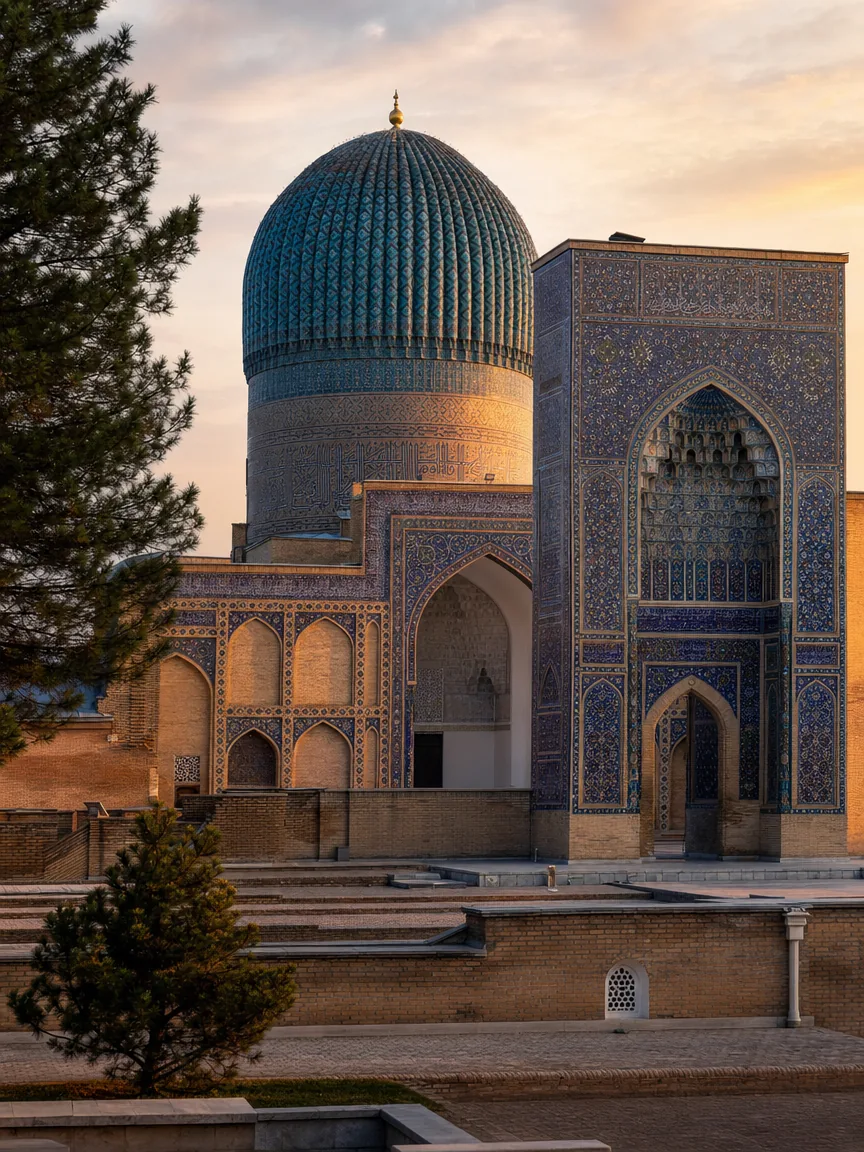
This tomb was not built for Timur.
Эту гробницу строили не для Тимура.
In 1403 Muhammad Sultan — his grandson and named heir — died suddenly, and the mausoleum was begun for him. Timur intended to lie in Shahrisabz, by the palace of his family. He died in February 1405 at Otrar, on the road to China, in winter; the passes to Shahrisabz were snowed in, and his body was brought here.
В 1403 году внезапно умер Мухаммад-Султан — внук и назначенный наследник, и мавзолей начали для него. Сам Тимур собирался лежать в Шахрисабзе, у родового дворца. Он умер в феврале 1405 года в Отраре, по дороге в Китай, зимой; перевалы на Шахрисабз занесло, и тело привезли сюда.
So four generations ended up in one chamber. Timur, two of his sons — Miran Shah and Shah Rukh — his grandson Muhammad Sultan and his grandson Ulugh Beg. Beside them, in a place of honour nearer the mihrab than the conqueror himself, is Sayyid Baraka, his spiritual teacher. The arrangement was not accidental, and it is the one detail of the interior worth understanding in advance: the graves in the hall are markers; the actual burials are below, in the crypt.
Так в одном зале оказались четыре поколения. Тимур, два его сына — Мираншах и Шахрух, внук Мухаммад-Султан и внук Улугбек. Рядом, на почётном месте ближе к михрабу, чем сам завоеватель, — Сайид Барака, его духовный наставник. Расположение выбрано не случайно, и это единственная деталь интерьера, которую стоит понять заранее: могилы в зале — надгробия, настоящие захоронения ниже, в склепе.
On 19 June 1941 a Soviet expedition opened the tomb. The anthropologist Mikhail Gerasimov reconstructed Timur's face from his skull — the portrait you have seen in textbooks; 172 cm tall, with old wounds in his right arm and leg that explain the name "the lame". According to the same expedition's report, the skeleton in Ulugh Beg's burial was found with the head severed, which matched the chronicles' account of his execution.
19 июня 1941 года советская экспедиция вскрыла гробницу. Антрополог Михаил Герасимов восстановил лицо Тимура по черепу — тот самый портрет, который вы видели в учебниках; рост 172 см, следы старых ранений в правой руке и ноге, объясняющие прозвище «хромой». По отчёту той же экспедиции, в захоронении Улугбека нашли скелет с отделённой головой — это совпало с летописным описанием его казни.
The work finished on 20 June. On the twenty-second, the war began. You will be told about this coincidence at the entrance, along with the curse said to be inscribed on the tomb — and it is better to know beforehand that the existence of that inscription is disputed, and that a coincidence of dates remains a coincidence of dates.
Работа закончилась 20 июня. Двадцать второго началась война. Об этом совпадении вам расскажут у входа, добавив про надпись-проклятие на надгробии — и лучше знать заранее, что существование этой надписи оспаривается, а совпадение дат от этого не перестаёт быть совпадением дат.
What to look at. The interior, not the façade: the ribbed dome outside is the famous one, but the hall inside — gold worked over papier-mâché — is stronger. Half an hour to an hour.
На что смотреть. Интерьер, а не фасад: ребристый купол снаружи знаменит, но зал внутри — с золотой росписью по папье-маше — сильнее. Полчаса-час.
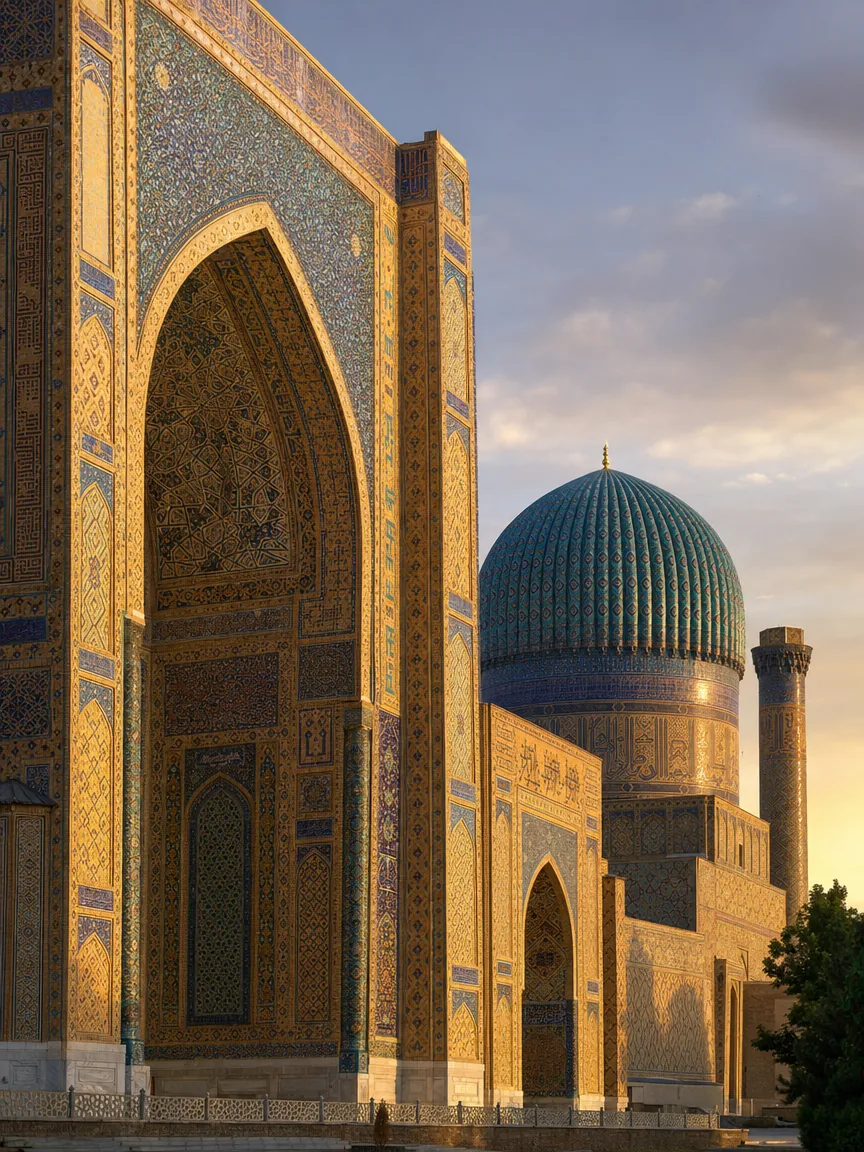
Timur set out to build a mosque here larger than anything he had seen — and it came apart almost at once.
Тимур строил здесь мечеть, которая должна была быть больше всего, что он видел, — и она развалилась почти сразу.
The idea came after the Indian campaign of 1399: plunder and craftsmen arrived from Delhi, and on them a congregational mosque was founded — a courtyard 167 by 109 metres, a portal thirty-five metres high, a dome of around forty. By the time Timur returned from his next campaign in 1404 it was nearly finished. The structural trouble began from the very start: the scale outran the engineering of its time. The building fell apart over four hundred years and reached ruin; the portal's arch collapsed in the earthquake of 1897. What you see has been restored — reconstruction began in 1974 and ran for decades.
Замысел появился после индийского похода 1399 года: из Дели пришли добыча и мастера, и на них была заложена соборная мечеть — двор 167 на 109 метров, портал в тридцать пять метров, купол около сорока. Когда Тимур вернулся из следующего похода в 1404-м, стройка почти закончилась. Проблемы с прочностью начались с самого начала: масштаб опережал инженерию своего времени. Здание разрушалось четыреста лет и добралось до руин; арка портала обвалилась при землетрясении 1897 года. То, что вы видите, восстановлено — реконструкция началась в 1974 году и шла десятилетиями.
This is worth knowing beforehand, because otherwise Bibi-Khanym reads simply as a large mosque. It is a monument to a limit: here you can see where the possible ends, even when the order is given by a man no one refuses.
Знать это стоит заранее, потому что иначе Биби-Ханым читается просто как большая мечеть. А это памятник границе: здесь видно, где заканчивается возможное, даже если приказ отдаёт человек, которому не отказывают.
In the courtyard stands a marble Quran rest, a gift from Ulugh Beg: two huge wedge-shaped blocks on a plinth. The Quran of Uthman, a seventh-century manuscript, once lay on it; in 1875 the Russian administration took the manuscript to St Petersburg and moved the rest out of the prayer hall into the courtyard, where it stands now.
Во дворе — мраморная подставка для Корана, дар Улугбека: два огромных клиновидных блока на постаменте. На ней лежал Коран Османа, рукопись VII века; в 1875 году русская администрация вывезла рукопись в Петербург, а подставку перенесла из молитвенного зала во двор, где она и стоит.
The mosque carries the name of Timur's senior wife, Saray Mulk Khanum. By several sources she was also the one who commissioned it, not merely the one it was named for.
Мечеть носит имя старшей жены Тимура, Сарай-Мульк-ханым. По ряду источников она и была заказчицей строительства, а не только той, чьё имя дали зданию.
Legend has it otherwise: that the architect, building the mosque in Timur's absence, fell in love with the queen and refused to finish the dome until she let him kiss her; the kiss left a mark on her cheek, Timur returned and learned everything. This is a local legend, not an episode of biography — it has no historical confirmation. But it has been told here for six hundred years, and without it Samarkand would be a different city: a legend is also part of how a city remembers itself.
Предание рассказывает другое: будто зодчий, строивший мечеть в отсутствие Тимура, влюбился в царицу и отказался достраивать купол, пока она не позволит себя поцеловать; поцелуй оставил след на щеке, Тимур вернулся и всё узнал. Это местная легенда, а не эпизод биографии — исторических подтверждений у неё нет. Но её здесь рассказывают шестьсот лет, и без неё Самарканд был бы другим городом: предание — тоже часть того, как город себя помнит.
When to come. In the morning, before the coaches, and be sure to step into the courtyard — from outside the building looks smaller than it is. Forty minutes.
Когда приходить. Утром, до автобусов, и обязательно зайдите внутрь двора — снаружи здание кажется меньше, чем есть. Сорок минут.
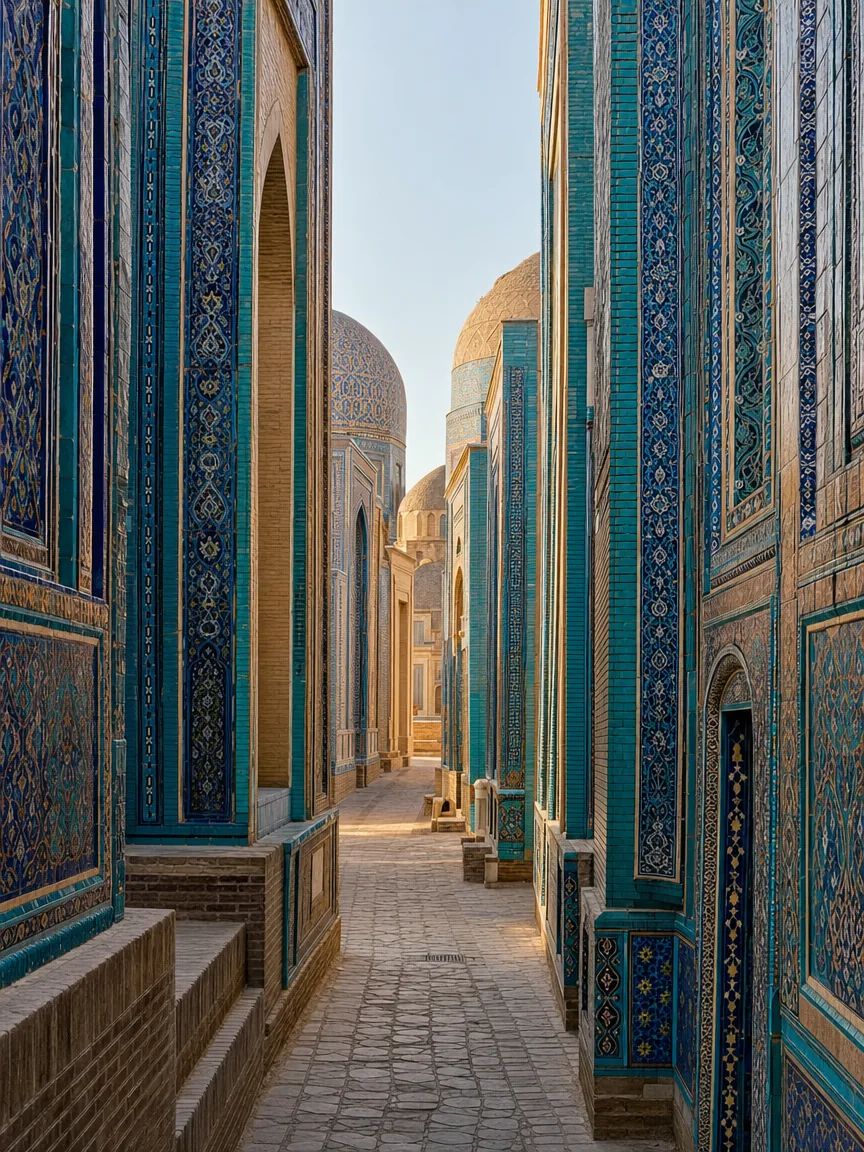
This is not one monument but a street of them — and it took eight hundred years to build.
Здесь не один памятник, а улица из них — и она строилась восемьсот лет.
At the base of everything is the grave of Qutham ibn Abbas, a cousin of the Prophet, who came to preach in Samarkand in the seventh century. The legend says he was beheaded during prayer, picked up his own head and walked with it into a well, where he lives still. Hence the name: Shah-i-Zinda, "the living king". This is legend, not biography — but it is what made the hill sacred: when Genghis Khan levelled the city in 1220, the complex of Qutham ibn Abbas survived.
В основании всего — могила Кусама ибн Аббаса, двоюродного брата Пророка, пришедшего проповедовать в Самарканд в VII веке. Предание говорит, что его обезглавили во время молитвы, он поднял свою голову и ушёл с ней в колодец, где живёт до сих пор. Отсюда имя: Шахи-Зинда — «живой царь». Это предание, а не факт биографии, но именно оно сделало холм священным: когда в 1220 году Чингисхан снёс город, комплекс Кусама ибн Аббаса уцелел.
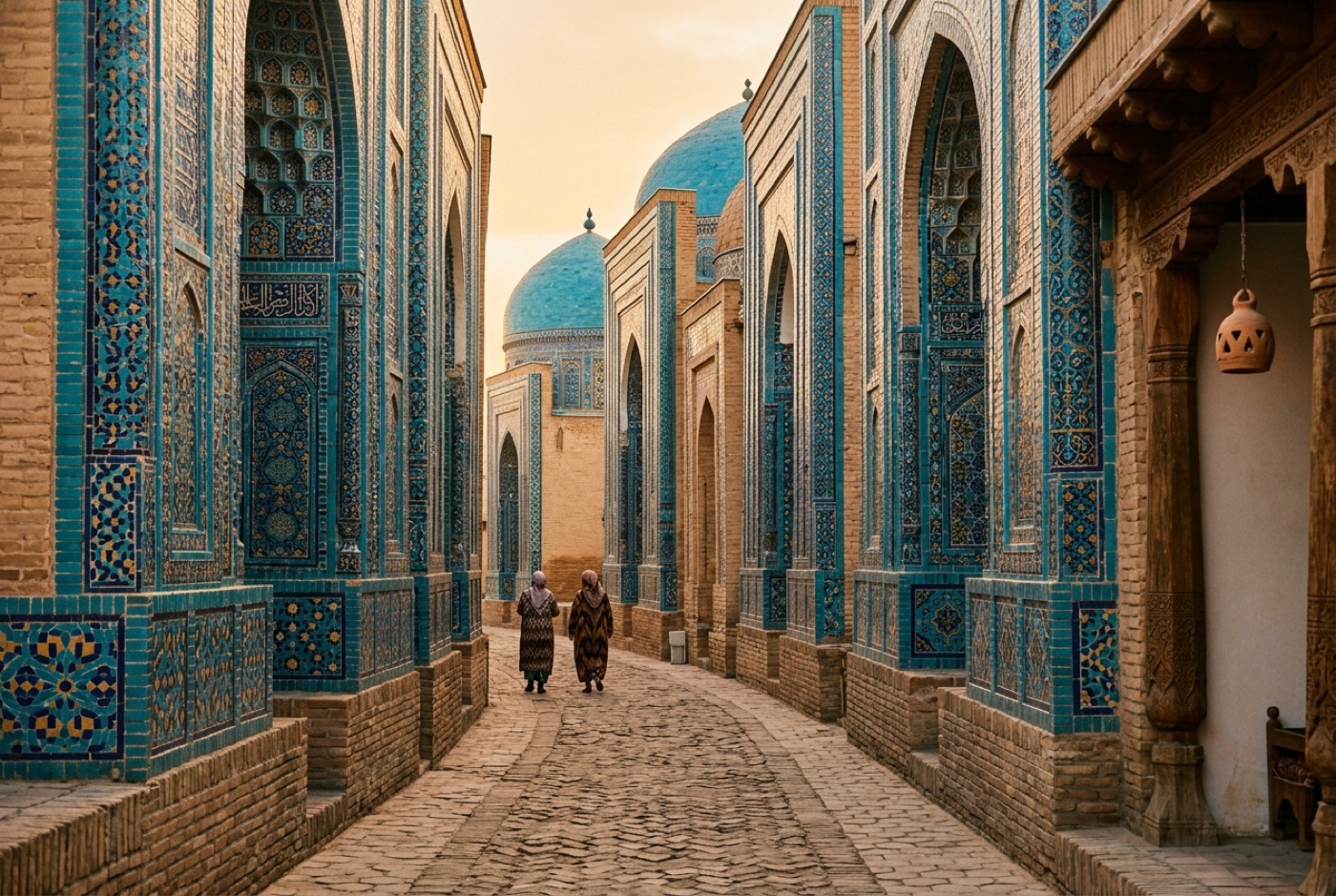
Afterwards, those close to the ruling family were buried around the shrine — and nearly everyone whose name is written here is a woman. The mausoleum of 1372 was built by Turkan Aka for her dead daughter Shadi Mulk, and eleven years later she was laid beside her. The mausoleum of Shirin Bika Aka, Timur's sister, dates from 1385–1386. There is a scholar's tomb too: Qazi Zada Rumi, Ulugh Beg's teacher in mathematics, was buried here under a double dome in 1434–1435.
Дальше вокруг святыни хоронили тех, кто был близок правящей семье, — и почти все, чьи имена здесь написаны, женщины. Мавзолей 1372 года Туркан-ака построила для своей умершей дочери Шади-Мульк, а через одиннадцать лет легла рядом с ней. Мавзолей Ширин-бика-ака, сестры Тимура, — 1385–1386 годов. Есть и мавзолей учёного: Кази-заде Руми, учителя Улугбека по математике, похоронен здесь под двойным куполом в 1434–1435 годах.
Walk slowly and look up. The street is narrow, the portals stand close together, and the tilework is the thing: over a century of work the technique and the palette changed, and across a hundred metres you can watch the hand change with them.
Идти нужно медленно и смотреть вверх. Улица узкая, порталы стоят вплотную, и главное здесь — изразцы: за век работы майолики менялись техника и палитра, и на протяжении сотни метров видно, как менялась рука.
What to notice. At the entrance is a staircase locals call the sinners' stair: you count the steps going up and count them again coming down; if the numbers agree, your sins are forgiven. The number people give varies, and that is part of the pleasure. This is a living belief, not a museum label, and it is worth trying.
На что обратить внимание. У входа — лестница, которую местные называют лестницей грешников: поднимаясь, ступени считают, спускаясь — пересчитывают; сойдётся — грехи прощены. Число называют разное, и в этом часть удовольствия. Это живое поверье, а не музейная табличка, и стоит попробовать.
An hour, better an hour and a half. Morning gives the best light: the street runs so that one side of it is always in shadow by day.
Час, лучше полтора. Утро — лучший свет: улица ориентирована так, что днём одна её сторона всегда в тени.
One arc in the ground is all that is left of it — and that is enough to understand why you came.
От неё осталась одна дуга в земле — и этого достаточно, чтобы понять, зачем сюда идти.
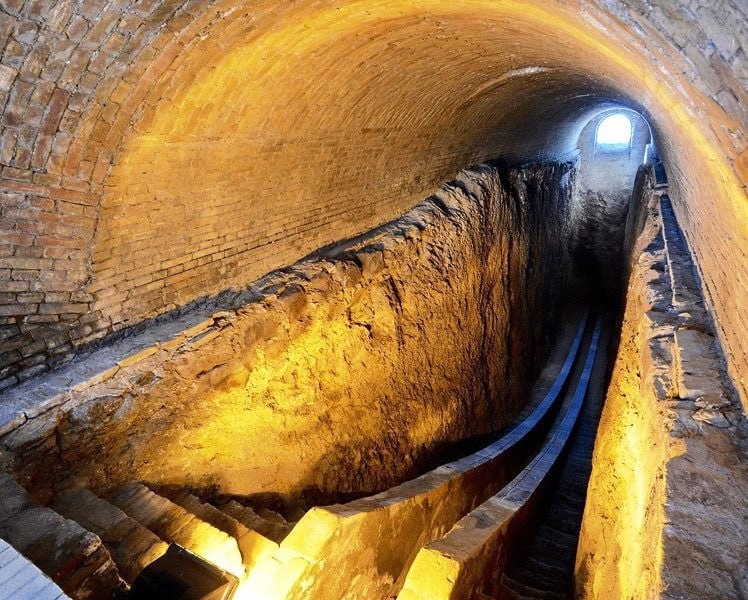
Ulugh Beg laid the observatory down in the 1420s and finished it around 1428. Its main instrument was a giant sextant with a radius of just over forty metres, aligned to the meridian: for an arc that size to fit, its lower part was sunk into the hill, into a trench. One degree took up seventy centimetres along it — hence a precision unreachable at any smaller scale.
Улугбек заложил обсерваторию в 1420-х и достроил около 1428 года. Главным инструментом был гигантский секстант радиусом чуть больше сорока метров, ориентированный по меридиану: чтобы такая дуга поместилась, её нижнюю часть вкопали в холм, в траншею. Один градус занимал на ней семьдесят сантиметров — отсюда точность, недостижимая при меньших размерах.
The result of that work is the Zij-i Sultani, the star catalogue of 1437: around a thousand stars, measured afresh rather than copied from the Greeks. Ulugh Beg fixed the length of the year to within twenty-five seconds. He measured the tilt of the earth's axis to an accuracy Europe would not better for a long time.
Результат этой работы — «Зидж-и Султани», звёздный каталог 1437 года, около тысячи звёзд, измеренных заново, а не переписанных у греков. Длину года Улугбек определил с ошибкой в двадцать пять секунд. Наклон земной оси — с точностью, которую в Европе превзошли много позже.
After he was killed in 1449 the observatory was destroyed. The site was lost for four hundred and fifty years: in 1908 the Russian archaeologist Vasily Vyatkin found the buried part of the sextant — the very arc you are about to walk down to.
После его гибели в 1449 году обсерваторию разрушили. Место потеряли на четыреста пятьдесят лет: в 1908 году русский археолог Василий Вяткин нашёл подземную часть секстанта — ту самую дугу, к которой вы сейчас спуститесь.
There is, frankly, nothing to look at here — and that is the whole point. You stand over a piece of marble in a trench, and it is the only thing physically left of the place where, in the fifteenth century, a man measured the year more precisely than it was measured anywhere on earth.
Смотреть здесь, честно говоря, нечего — и в этом всё дело. Вы стоите над куском мрамора в траншее, и это единственное, что физически осталось от места, где человек в пятнадцатом веке измерил год точнее, чем это умели где-либо на земле.
How long to allow. Half an hour for the arc itself, another half for the museum beside it if instruments and manuscripts interest you. Best combined with Shah-i-Zinda — they are on the same side of the city.
Сколько закладывать. Полчаса на саму дугу, ещё полчаса на музей рядом, если интересны инструменты и рукописи. Совмещать лучше с Шахи-Зинда — они в одной стороне города.

OnwardДальше
Signature Journey 01Авторское путешествие 01
The Silk Road, Privately
High-speed trains carry you from Tashkent to Samarkand, Bukhara and Khiva, and on every platform a private transfer is already waiting.Скоростные поезда везут вас из Ташкента в Самарканд, Бухару и Хиву, а на каждом перроне уже ждёт личный трансфер.
Discover the journey →Открыть путешествие →
Signature Journey 02Авторское путешествие 02
Made in Uzbekistan
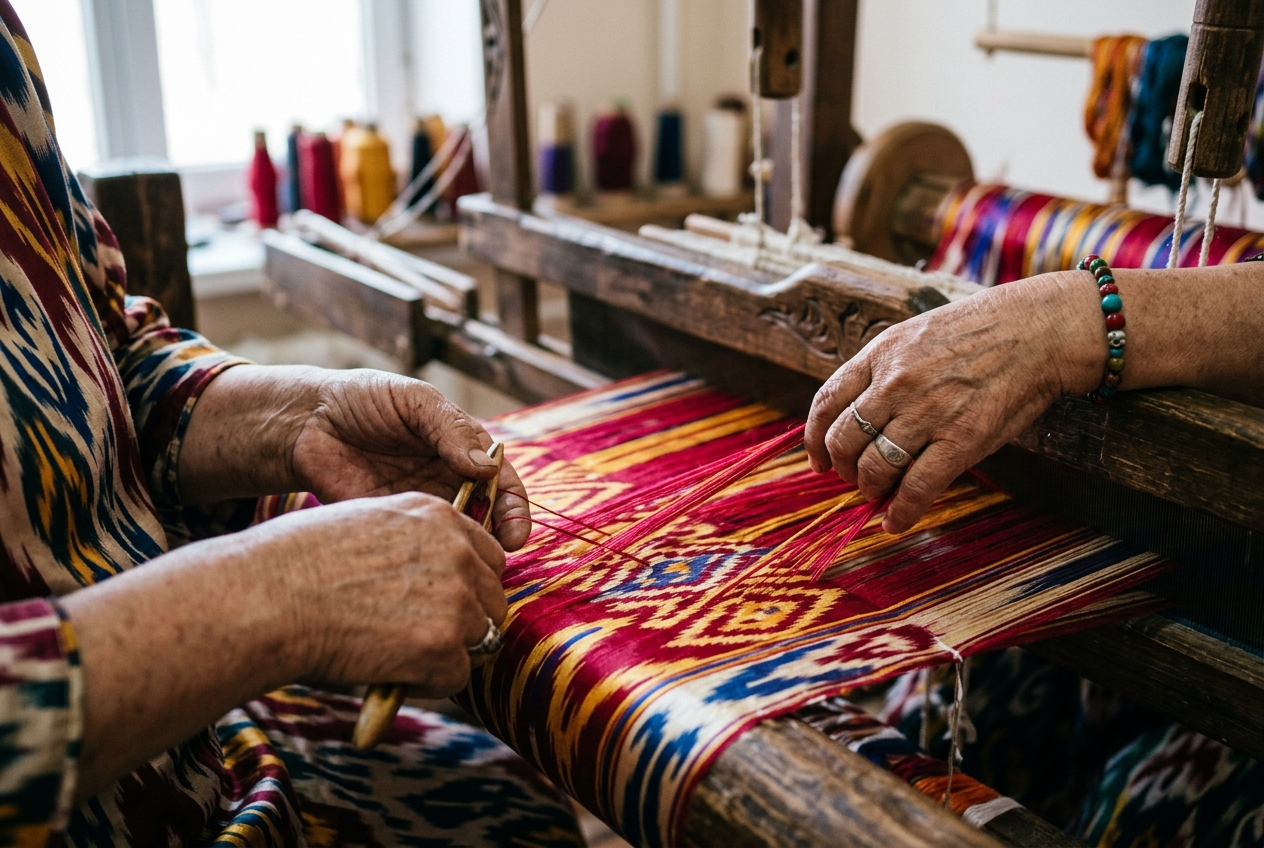
After several days among the people who make things by hand, you see Samarkand differently.После нескольких дней среди тех, кто создаёт вещи руками, Самарканд видишь иначе.
Discover the journey →Открыть путешествие →